AI Memory & Reasoning Capture
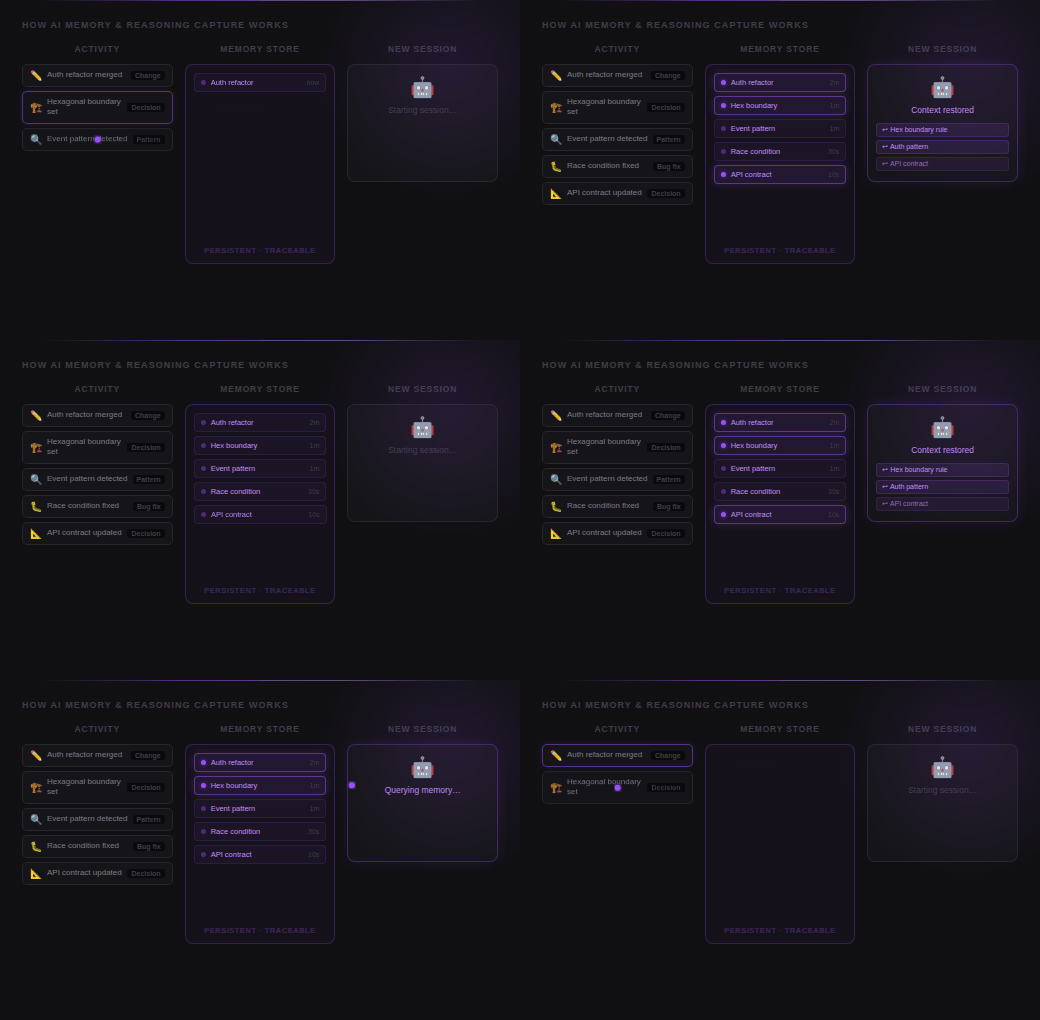
Every AI coding session starts from scratch — the agent that helped you refactor yesterday has no memory of why. AI memory systems fix that by capturing, storing, and indexing the full reasoning chain behind every code change. This hub covers the complete lifecycle: Draft Commits, Committed Checkpoints, reasoning capture, local-first memory architectures, and the compounding effect that makes every future session smarter than the last.
Hub visual
The Problem Space
The first three articles establish why memory matters and what happens without it.
- Why AI Coding Agents Need Memory — The anchor article. Every AI session starts stateless — no memory of past decisions, no awareness of constraints discovered last week, no accumulated understanding. This article walks through the real cost of that amnesia and maps the spectrum from stateless to shared team memory.
- Why AI Intent Matters — "The Missing Loop." Git captures diffs but not reasoning. When an agent generates code, the full decision chain — constraints considered, alternatives rejected, tradeoffs evaluated — disappears when the session closes. This article explains why commit messages and code comments don't solve the problem.
The Capture Mechanism
These articles explain how AI coding activity is actually recorded — the mechanics of turning ephemeral agent sessions into permanent, queryable records.
- Draft Commits Explained — Temporary, in-progress checkpoints captured in real time as an AI agent works. Draft Commits record everything: the conversation, what changed and what didn't, which model was used, the reasoning chain, and alternatives the agent considered. They're the live record of AI activity before it becomes permanent.
- Committed Checkpoints Explained — When you commit to git, Draft Commits become Committed Checkpoints — permanent, immutable records tied to the git commit hash. This article covers what they contain, why immutability matters for audit trails, and how they create a second layer of history parallel to git.
- Capturing Reasoning Behind AI Code Changes — The key differentiator. Not just recording what code was generated, but preserving the full reasoning chain: decisions, constraints, alternatives considered, and why the agent went one direction instead of another. This is what makes captured history actually useful for future sessions.
- From AI Session to Permanent Commit History — The end-to-end workflow. Developer starts a session → agent works and generates Draft Commits → developer commits → Bitloops creates a Committed Checkpoint → checkpoint is indexed and queryable. Walk through the complete lifecycle with concrete examples.
Memory Architecture
The technical layer: how captured reasoning is stored, indexed, and retrieved.
- Structural Memory vs. Semantic Memory — The key architectural distinction. Structural memory is computed on-the-fly via AST parsing (always fresh, never stored). Semantic memory is persisted in the knowledge store (accumulated, compounding). This article explains why they're separated and how they complement each other.
- Local-First AI Memory Architectures — The technical implementation: SQLite for structured queries, HNSW vector index for semantic similarity, stored locally in a hidden directory scoped to the repository. No server, no network dependency, no data leaves the machine. Covers the tradeoffs vs. cloud-hosted alternatives.
- Vector Databases for Code Context — A technical survey of vector databases and indexes for code: HNSW, FAISS, pgvector, Pinecone, Qdrant, and others. What gets embedded, how code embeddings work, and practical guidance for choosing the right approach for your use case.
The Compounding Effect
Memory isn't just storage — it's an asset that grows more valuable over time. These articles explain why.
- How Memory Compounds Over Time — A codebase with six months of captured reasoning is dramatically richer than one set up yesterday. Every Committed Checkpoint adds to the record. Every session refines semantic understanding. Every developer's and agent's captured reasoning benefits everyone who comes after.
- Memory-Driven Improvement Loops — The feedback loop: capture → retrieve → improve → capture again. Violations caught become future context. Decisions recorded become future guidance. This isn't manual "lessons learned" — it's automatic, continuous improvement built into the development workflow.
- Measuring and Querying AI Decision History — What you can actually do with all this captured intelligence: query session history, trace decision chains for any commit, measure AI usage patterns across your team, and build the governance visibility that engineering managers and CTOs need.
Where This Hub Connects
- Context Engineering — Context engineering delivers knowledge to agents. This hub covers how that knowledge gets captured and accumulated in the first place. The two are two halves of a closed loop.
- AI Code Governance & Quality — Governance needs audit trails and traceability. Committed Checkpoints provide exactly that — a complete record of how every AI-generated commit was produced.
- AI-Native Software Development — Memory changes how teams work with AI. Instead of treating each session as isolated, teams build on accumulated understanding that compounds across developers and projects.
- Agent Tooling & Infrastructure — The infrastructure layer that memory systems run on. Tool calling, MCP, and agent orchestration are the delivery mechanisms through which agents access stored memory.
Suggested reading order
If you're reading this hub end to end, this sequence builds understanding progressively. Each article stands alone, but they are designed to compound.
12
Articles
~96 min
Total read
Why AI Coding Agents Need Memory
FoundationWithout memory, every session is amnesia—the agent forgets constraints, rediscovers patterns, repeats mistakes. With memory, agents learn. They get better. They compound your team's knowledge instead of wasting it.
Why AI Intent Matters
FoundationGit captures what changed, but not why. When an AI agent generates code, the reasoning—the prompt, constraints considered, alternatives rejected—disappears with the session. Discover why intent is the missing link in AI-driven development and what a complete intent record actually looks like.
Draft Commits Explained
FoundationDraft Commits capture the agent's work in progress—intermediate states, reasoning, false starts, and corrections—all before the final git commit. They're how you understand what the agent tried, why it changed direction, and how it arrived at the final code.
Committed Checkpoints Explained: From Draft to Permanent Record
FoundationGit saves code. Checkpoints save everything else—the prompts, reasoning, decisions, and intent behind the code. They're immutable records tied to every commit, making AI-generated code fully auditable and learned from.
Capturing Reasoning Behind AI Code Changes: The Real Differentiator
Core patternsWhen an agent makes a choice, capture why—the constraints it discovered, the alternatives it rejected, the trade-offs it weighed. Without this, you've got code but no understanding. With it, the next session can learn instead of starting blind.
From AI Session to Permanent Commit History: The Complete Workflow
Core patternsA session starts with drafts, moves through review, becomes a git commit, and gets indexed as a checkpoint. The entire flow is automatic and invisible. Your AI work transforms from session-only knowledge into permanent, searchable institutional memory.
Structural Memory vs Semantic Memory: Two Kinds of Code Context
Core patternsStructural memory answers 'what is connected?'—it's computed fresh every time. Semantic memory answers 'why does it matter?'—it accumulates over time. Agents need both: precision from structure, wisdom from semantics.
Local-First AI Memory Architectures: SQLite + HNSW for Code Context
Core patternsKeep your AI's memory local—SQLite plus vector indexes on your machine. You get privacy, no vendor lock-in, offline-first access, and full control. The trade-off is worth it: your codebase knowledge stays yours.
Vector Databases for Code Context: Choosing the Right Index
Applied practiceVector databases make semantic search possible—but which one? HNSW is fast and keeps data local. Postgres with pgvector integrates with your stack. Cloud platforms scale without ops. Pick based on your privacy needs and scale, not hype.
How Memory Compounds Over Time
Applied practiceEvery decision captured becomes a teaching moment for the next session. Memory compounds—decisions inform future decisions, constraints get discovered once and applied everywhere. Six months of history makes your agents exponentially better than day one.
Memory-Driven Improvement Loops in AI Coding
Applied practiceCapture decisions, retrieve them next time, improve the code, repeat. Every mistake caught becomes a constraint the agent learns. Every good pattern becomes future guidance. That's how you transform one-off fixes into compounding improvements.
Measuring and Querying AI Decision History
Applied practiceEvery decision an agent makes creates data. Query it to understand what patterns succeed, what constraints matter, where rework happens. That's how teams move from 'the AI made this' to 'the AI learned that.'
Get Started with Bitloops.
Apply what you learn in these hubs to real AI-assisted delivery workflows with shared context, traceable reasoning, and architecture-aware engineering practices.
curl -sSL https://bitloops.com/install.sh | bash Get Started
 GitHub
 Discord
Related articles
Context Windows vs External Memory: When to Keep Knowledge In-Context
Context windows are expensive and finite. Some knowledge always matters (load it once). Some matters rarely (fetch on demand). Learn which is which, and you'll build agents that are cheaper, faster, and way less likely to hallucinate.
Semantic Context for Codebases: Understanding Why Code Exists
Structural context tells you what code does. Semantic context tells you why it exists—the problem it solves, the trade-offs it makes, the patterns it follows. Agents without semantic context are pattern-matchers; with it, they're decision-makers.
Traceability from Prompt to Commit: The Complete Chain for AI-Generated Code
Trace every line of AI code back to its prompt. What was asked? What did the agent consider? What constraints mattered? Complete traceability prevents debugging nightmares and compliance failures.
Seeing What Agents Do: Observability for AI-Driven Development
Agent observability isn't traditional logging—you need to trace decisions, monitor tool calls, measure reasoning quality, and track context utilization. Without it, agents work great in demos but fail silently in production. This is how you see what agents actually do.
Scaling Teams with AI Coding Agents
Hiring more people for more features creates overhead, coordination chaos, culture dilution. With AI agents, teams maintain size and amplify output. Humans focus on decisions and reviews; agents do implementation. The skills you need change fundamentally.
Documentation as Infrastructure
Documentation in repos, reviewed in PRs, and versioned with code actually stays current. When you treat docs like code, they become contracts between teams instead of outdated wiki pages nobody reads.