Engineering Best Practices
Best practices aren't dogma — they're the patterns and disciplines that consistently make engineering teams faster, more reliable, and less likely to ship bugs to production. The good ones compound over time as foundations keep paying off. This hub covers testing strategies at scale, CI/CD pipeline design, code review in AI-assisted teams, documentation as infrastructure, coding conventions, versioning, data contracts, error handling, and accessibility. Every article is practical and opinionated.
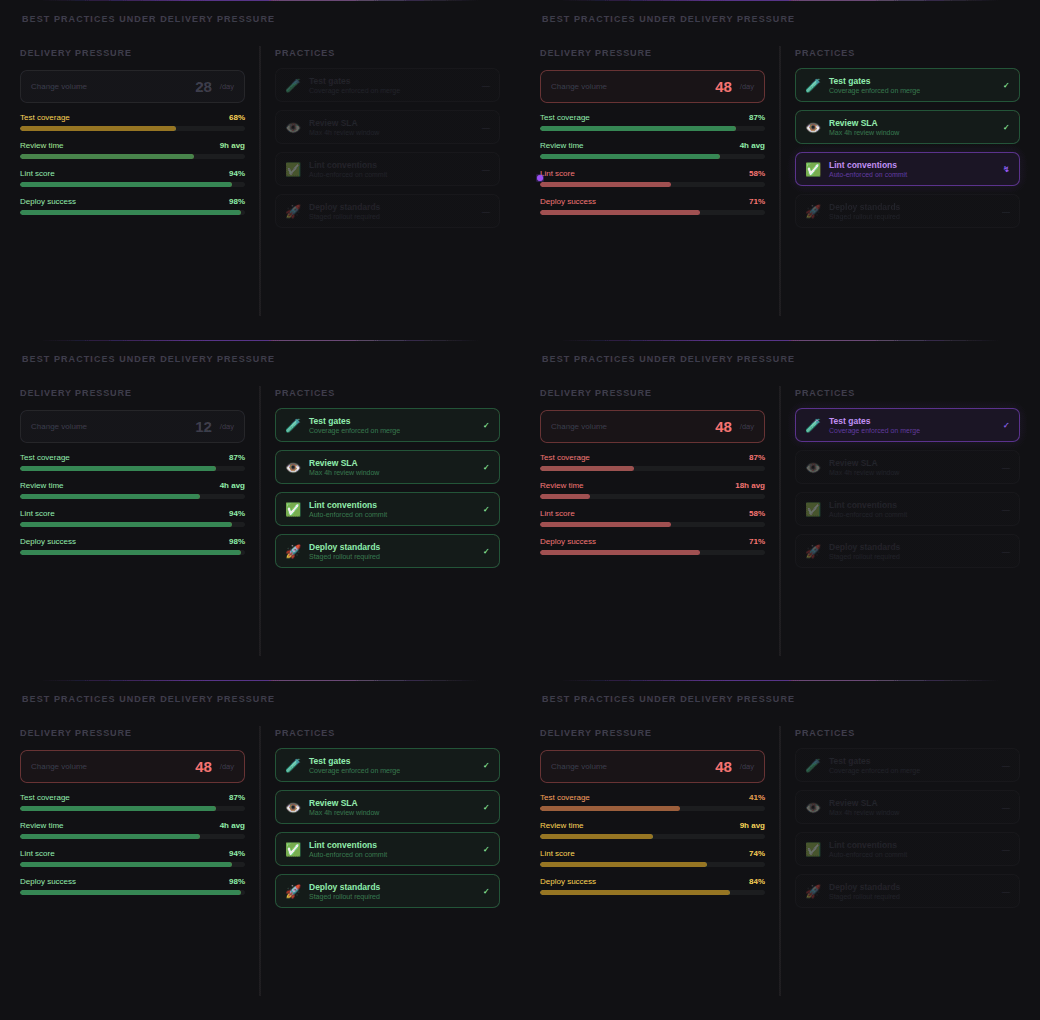
Hub visual
Foundations
- What Are Engineering Best Practices? — The anchor article. What best practices are (vs. cargo-cult dogma), how to establish them, the tension between standardization and flexibility, and how best practices adapt in the AI era.
- Codebase Conventions and Standards — Naming, file structure, code style, import ordering, comment conventions. Why consistency reduces cognitive load, how to enforce it with tooling, and the balance between too few rules and too many.
Testing & Quality
- Testing Strategies for Large Systems — The testing pyramid (and its alternatives), what to test at each level, dealing with external dependencies, property-based testing, mutation testing, and practical strategies for maintaining test quality at scale.
- CI/CD Best Practices — What CI/CD actually means (not just "we use GitHub Actions"), pipeline design, stage ordering, caching, parallelism, common mistakes, and how CI/CD adapts for AI-generated code.
Review & Documentation
- Code Review in AI-Assisted Teams — How the review process changes when agents generate code: what to look for, practical checklists, how reasoning traces transform the experience, and the balance between thoroughness and velocity.
- Documentation as Infrastructure — Docs aren't an afterthought — they're infrastructure. Types of documentation, docs-as-code workflows, keeping docs current, and why documentation is context for AI agents (not just for humans).
Contracts & Compatibility
- Versioning and Backward Compatibility — Semantic versioning, API versioning strategies, deprecation, schema evolution, and practical patterns for evolving public APIs without breaking consumers.
- Data Contracts and System Boundaries — Explicit agreements about data shape and semantics between systems. Consumer-driven contracts, Pact testing, syntactic vs. semantic contracts, and practical implementation.
Resilience & Accessibility
- Error Handling and Resilience Patterns — Fail fast vs. fail gracefully, exception hierarchies, error boundaries, retry patterns, circuit breakers, bulkheads, timeout strategies, graceful degradation, and building systems that handle failure well.
- Accessibility Fundamentals — WCAG compliance, the POUR principles, semantic HTML, ARIA, keyboard navigation, screen reader testing, and integrating accessibility into the development workflow instead of treating it as an afterthought.
Where This Hub Connects
- AI Code Governance & Quality — Governance extends best practices into the AI domain. Pre-commit hooks, CI validation, and code review take on new importance when agents generate code.
- Software Design — Design principles like SOLID, TDD, and DDD produce the code that best practices protect. Good design and good process reinforce each other.
- Software Architecture — Architectural decisions set the boundaries that best practices operate within. CI/CD pipelines, testing strategies, and conventions all exist in the context of your architecture.
- AI-Native Software Development — The AI-native paradigm changes which best practices matter most. Code review becomes paramount, documentation becomes agent context, and testing strategies adapt for AI-generated code.
Suggested reading order
If you're reading this hub end to end, this sequence builds understanding progressively. Each article stands alone, but they are designed to compound.
10
Articles
~80 min
Total read
What Are Engineering Best Practices?
FoundationEngineering best practices are proven patterns, processes, and disciplines that make teams consistently effective. They're not dogma—they're tools that reduce friction, improve quality, and speed up onboarding while leaving room for innovation and adaptation.
Codebase Conventions and Standards
FoundationConsistent naming, file structure, and style reduce cognitive load. Automate conventions with linters and hooks so reviewers focus on logic, not formatting. One agreed-upon standard beats ten engineers doing it their own way.
Testing Strategies for Large Systems
FoundationTest smart: many unit tests, fewer integration tests, fewer end-to-end tests. Use property-based testing and mutation testing to catch bugs that regular tests miss. The wrong test mix wastes effort without catching real problems.
CI/CD Best Practices
Core patternsCI/CD is the feedback loop that catches problems before they reach production. Fast feedback means developers fix issues while they remember what they wrote. Safe deployments mean you can ship multiple times a day without fear.
Code Review in AI-Assisted Teams
Core patternsAI generates code fast, but volume overwhelms traditional reviews. Good reviews shift focus from style (let linters handle that) to architecture and domain correctness. You need new checklists for AI-generated code.
Documentation as Infrastructure
Core patternsDocumentation in repos, reviewed in PRs, and versioned with code actually stays current. When you treat docs like code, they become contracts between teams instead of outdated wiki pages nobody reads.
Versioning and Backward Compatibility
Applied practiceBackward compatibility means your consumers don't break when you change. Semantic versioning signals what's safe to upgrade and what might break. Clear deprecation timelines give teams space to migrate.
Data Contracts and System Boundaries
Applied practiceData contracts are explicit agreements about what data looks like and what it means. They're how systems stay independent—one team can change their internals as long as the contract holds.
Error Handling and Resilience Patterns
Applied practiceSystems fail—networks timeout, services crash, data corrupts. Good error handling keeps you running when parts break. Retry patterns, circuit breakers, and bulkheads stop cascading failures and keep users from seeing 500 errors.
Accessibility Fundamentals
Applied practiceAccessible software works for everyone—blind users, people without a mouse, people with slow connections. It's not an afterthought; it's a requirement. Good accessibility benefits everyone, not just people with disabilities.
Get Started with Bitloops.
Apply what you learn in these hubs to real AI-assisted delivery workflows with shared context, traceable reasoning, and architecture-aware engineering practices.
curl -sSL https://bitloops.com/install.sh | bash Get Started
 GitHub
 Discord
Related articles
SOLID Principles: Five Rules for Better Code
SOLID principles prevent code from turning into an untouchable mess. They're not dogma—they're guidelines that solve real problems. Follow them where they matter, ignore them where they don't.
Architectural Tradeoffs and Decision Frameworks
Every architecture trades off simplicity, scaling, team autonomy, and complexity. The right choice depends on domain complexity, team size, scaling pressure, and consistency requirements. Use a decision framework to be explicit about constraints instead of copying what others do.
Reviewing AI-Generated Diffs with Context: From Pattern-Matching to Understanding
Without reasoning traces, reviews are guesswork. With them, reviewers understand *why* the agent made its choices. They can verify intent, catch subtle bugs, and actually provide useful feedback instead of rubber-stamping.
When Should an Agent Fetch Context? Decision Timing and Cost Analysis
Every tool call costs latency. Every gap in context costs quality. The question isn't 'should agents fetch?' it's 'when?' Learn signal-based triggers that tell agents exactly when to fetch, avoiding both over-fetching and under-fetching.
Designing Processes for AI-Driven Teams
Existing team processes break with agent-generated code. Sprint planning shifts from effort estimation to specification quality. Code review becomes the bottleneck. Standups change structure. Documentation becomes context. Redesign or you'll fail.
How Memory Compounds Over Time
Every decision captured becomes a teaching moment for the next session. Memory compounds—decisions inform future decisions, constraints get discovered once and applied everywhere. Six months of history makes your agents exponentially better than day one.